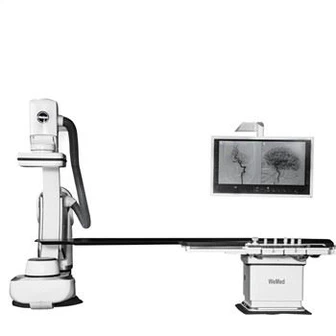
Pioneering Breakthrough: We-RTNavi Unlocks The Code Of Blood Vessels For Automated Navigation
Real-time coronary navigation represents a cutting-edge research direction in cardiac intervention. WeMed Medical's latest We-RTNavi technology, building on the existing Dynamic Coronary Roadmap (DCR) functionality, not only enhances real-time motion compensation but also incorporates the ability to identify and track guidewires in real time. This allows for continuous guidewire positioning and high-contrast overlay of angiographic dye.
Until now, the market has only offered similar functionality through Dynamic Coronary Roadmap (DCR). However, WeMed Medical has quietly set a new benchmark with the recent launch of We-RTNavi (Real-Time Coronary Navigation). What sets Real-Time Coronary Navigation apart? How will it revolutionize the field of coronary interventions? Today, we unveil the mystery behind this groundbreaking advanced feature in DSA systems-Real-Time Coronary Navigation.
Real-Time Coronary NavigationFrom Vision to Innovation
For a long time in the development of interventional procedures, the functionality of interventional treatments remained relatively simple. DSA-based angiographic images were primarily used to provide doctors with a general reference of the vascular path during procedures. However, since angiographic images do not reveal the guidewire's path within the vessels, the concept of roadmapping was introduced.
Early roadmapping generally referred to the concept of 2D roadmaps, where fluoroscopic images of the vessels were overlaid onto angiographic images without contrast injection, creating visual feedback with highlighted vascular paths and guidewire positioning. The advent of roadmapping technology undoubtedly opened a new era of intervention.

Undoubtedly, early roadmapping technology had several limitations, including issues with image quality, vascular extraction accuracy, and real-time performance. For instance, vascular images could be blurry, making it difficult for doctors to assess the vessel details accurately. Additionally, the extracted vascular paths were often imprecise, which could lead to potential errors during surgical procedures.
Moreover, traditional roadmapping often fails to account for the changes in blood vessels caused by physiological movements, such as breathing or heartbeat. This poses a significant challenge, especially in coronary interventions, where precision is critical.
With the advent of the digital age, advancements in computer technology, image processing, and artificial intelligence algorithms have driven significant progress in roadmapping technology.
This technology enables real-time dynamic extraction and matching of both vessels and guidewires. It not only visualizes the vascular "path" but also tracks the guidewire used in the treatment. This breakthrough overcomes the technical challenge in interventional procedures, where it is difficult for doctors to capture the real-time path of the guidewire due to physiological movements, enabling real-time vascular navigation during interventional treatments.
Based on hundreds of thousands of coronary scan sequences, AI algorithms perform deep learning and analysis on vast amounts of vascular image data, thoroughly studying the morphology, structure, and patterns of change in both vessels and guidewires.
Real-Time Coronary Navigation technology makes full use of clinical anatomical features, employing multi-faceted anatomical characteristics for precise matching while addressing the dual impacts of respiratory motion and heartbeat. Through advanced motion compensation techniques and algorithm optimization, it ensures that the accuracy of vessel and guidewire extraction and matching remains exceptionally high, even during the patient's physiological movements.
Within a single cardiac cycle, the guidewire's matching accuracy within the vessel significantly exceeds industry standards. This advantage is especially crucial in coronary intervention procedures, where the precise positioning of the guidewire is a critical factor for surgical success.
WeMed Medical's product and technology innovations have always been guided by its mission to "Innovation for Health". The company has high expectations for the clinical impact of its Real-Time Coronary Navigation technology.
For doctors, it significantly enhances both the convenience and precision of surgical procedures.
For patients, We-RTNavi means a safer and more efficient treatment experience.
Recent literature on DCR has provided evidence of its clinical significance. Several studies show that DCR offers advantages such as ease of data acquisition, high vascular fusion, and real-time fluoroscopic overlay. This technology has proven clinical benefits in reducing contrast agent usage, simplifying surgical procedures, and improving the safety of PCI surgeries.
Compared to Dynamic Coronary Roadmap, We-RTNavi is a more advanced DSA technology developed based on dynamic roadmapping. As more research is conducted, its clinical significance will continue to receive positive feedback over time, which is an inevitable outcome.