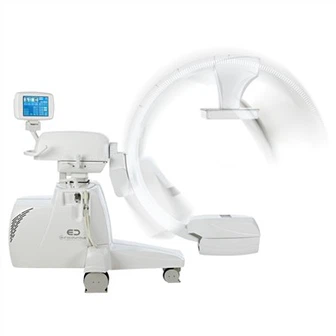
Procedure of Cardiovascular DSA
When an abnormality is suspected, a contrast agent (usually an iodine compound) should be injected into the lesion or into the chamber at a higher pressure. When the valve is not fully closed, the contrast agent is injected into the cavity adjacent to the valve at a higher pressure.
Biplane Cardiovascular Angiography can provide a three-dimensional image of the chambers and great blood vessels. Unlike a still film, a cardiac movie can be used for monitoring during the process of injecting a contrast agent, and the result can be synchronized with a video tape and can be played back immediately. Digital subtraction angiography is suitable for inactive arteries and cine vascular imaging of chambers.
Right ventricle and pulmonary valve" Contrast agent is injected directly into the apex of the right ventricle to record tricuspid valve function and display the pulmonary valve, subvalvular area and proximal pulmonary artery. When the patient takes the lateral position, the right ventricular outflow tract is clearly displayed and the relationship between the pulmonary artery and the aorta is shown. Occasionally, a ventricular septal defect or the connection between the right ventricle and the aorta can be seen.
"Pulmonary artery" pulmonary angiography is the most decisive technique for the diagnosis of acute pulmonary embolism; intracavitary filling defects or sudden interruption of arteries are diagnostic. The contrast agent is injected into the common pulmonary artery or the right ventricular outflow tract. For safety, a smaller amount of contrast agent can be selectively injected into one or both pulmonary arteries.
"Left atrium" space-occupying lesions (such as myxoma, blood clot) are common causes of left atrium insufficiency, but echocardiography is an alternative method for diagnosing these lesions. Injecting contrast media directly into these left atriums to show such lesions may be dangerous; instead, it is safe to use left-handed pulmonary angiography (such as dye filling from the pulmonary veins to the left atrium).
The right anterior oblique projection of the left ventricle from 30° to 45° best shows the long axis of the left ventricle and the area of left ventricular aneurysm or anterior wall dyskinesia, and separates the left atrium from the left ventricle so that the mitral valve can be seen Reflux. Left anterior oblique projection can distinguish the movement of the left ventricular outflow tract and subaortic area, as well as the ventricular septum and the posterior wall of the left ventricle. Cine angiography is used to evaluate left ventricular volume, wall motion and work. After clarifying the size and volume of the left ventricle in single-plane or dual-plane cardiovascular angiography, the end-systolic and end-diastolic volumes and ejection fraction can be calculated.
Aorta" Inject the contrast agent into the ascending aorta with a 60° left anterior oblique or left projection, and aortic regurgitation can be clearly seen. Coarctation of the aorta, patent ductus arteriosus, and aortic dissection can also be confirmed from aortic angiography.
The indications for coronary angiography of coronary arteries include unstable angina (including angina after myocardial infarction, which is ineffective or not completely relieved by appropriate medical treatment); atypical chest pain; valvular disease that can be corrected by valve replacement, especially with syncope or Patients with a history of angina; and unexplained heart failure, which may be caused by left ventricular aneurysm.