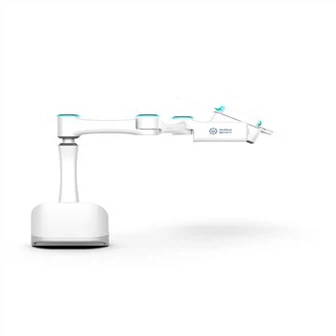
The Importance of Interventional Surgical Robots
Interventional surgical robots represent a major breakthrough in modern medical technology. Their significance is reflected in the following dimensions:
I. For Surgeons: A "Super Assistant" Beyond Human Limitations
1. A Leap in Precision
Elimination of Physiological Tremor: Robotic systems suppress micro-tremors through algorithmic filtering, achieving sub-millimeter stability.
Motion Scaling: A surgeon's 1 cm hand movement can be translated into a 1 mm instrument motion, enabling ultra-precise manipulation in anatomically complex regions.
2. Advanced Human–Machine Collaboration
Force Feedback: Sensor-based systems allow surgeons to perceive instrument–tissue interaction forces, reducing risks such as vessel perforation.
Intelligent Collision Avoidance: Automated safety boundaries prevent inadvertent injury to healthy tissues.
3. Reduced Occupational Burden
Seated operation minimizes fatigue, spinal strain, and radiation exposure associated with prolonged procedures and heavy lead protection.
II. For Patients: Safer and Less Invasive Care
1. Enhanced Procedural Quality
High-Definition 3D Visualization: Magnified stereoscopic imaging (10–15×) clearly delineates vascular branches and lesion margins.
High-Degree Instrument Articulation: Robotic arms provide up to 540° rotation, enabling access to anatomically challenging regions.
2. Lower Complication Rates
Increased precision reduces the risk of vessel rupture, organ perforation, and collateral tissue damage.
Shorter procedural times-particularly in complex cases-lower anesthesia-related and infectious risks.
3. Faster Recovery
Smaller incisions (or scarless natural-orifice access), reduced blood loss, less postoperative pain, and shorter hospital stays.
III. For Healthcare Systems: Technological Enablement and Model Innovation
1. Standardization of Complex Procedures
High-difficulty interventions (e.g., valve repair, superselective neuroembolization) become more reproducible and accessible, even in non-tertiary hospitals.
2. Advancement of Telemedicine
5G-Enabled Remote Robotics: Expert operators can perform procedures remotely, supporting emergency care in underserved regions, disaster scenarios, and extreme environments.
3. Data Integration and AI Support
Preoperative Planning: 3D reconstruction from CT/MRI data optimizes procedural pathways.
Intraoperative Navigation: Real-time image fusion highlights lesions and alerts surgeons to vascular anomalies.
Postoperative Analytics: Procedural data support training, workflow optimization, and outcome evaluation.
IV. Typical Application Scenarios
| Field | Limitations of Conventional Intervention | Advantages of Robotic Intervention |
|---|---|---|
| Coronary Intervention | Difficulty managing long or bifurcation lesions | Precise stent deployment, reduced malapposition |
| Neurointervention | High dependence on operator skill, elevated risk | Stable navigation in tortuous vessels for aneurysm coiling and thrombectomy |
| Oncologic Intervention | Needle positioning affected by respiratory motion | Respiratory-synchronized targeting with maximal tumor coverage |
| Percutaneous Puncture | Multiple adjustments increase bleeding/infection risk | Single-pass, high-precision targeting (e.g., lung nodules, renal stones) |
V. Challenges and Future Directions
Current Challenges
High system and consumable costs
Limited haptic feedback (under rapid improvement)
Steep learning curve requiring specialized training
Future Trends
AI-Assisted Automation: Partial automation of standardized procedural steps
Multi-Modal Image Fusion: Real-time integration of ultrasound, fluorescence, and angiographic data
Miniaturized Robotics: Micro-robots capable of navigating distal vessels or operating intraluminally